20 May 2013

10 Things I Don't Know How to Do

I saw this heading as a writing workshop prompt on another blog - http://www.mamakatslosinit.com, and thought it would make an interesting subject to undertake.  For me, it seems that the things which I cannot do frustrate me, challenge me, and ultimately build my character.  Of course there are some things I know I will never be able to do (such as being a Chippendale dancer).  So for this list I have chosen things which I at least have some chance at learning...

1. Lose gracefully
Let's face it.  Losing just plain sucks! Losing gracefully is an oxymoron.  The best I can do is try to pretend it doesn't bother me.  I never understood why tennis matches were supposed to end with a handshake, or why the NHL gave an award for "Gentlemanly Conduct".  But to my young nieces and nephews who may be reading this at some point in the future: I want you to know that even though I trounced you in foot races, took all your Monopoly money, and won all your candy while teaching you poker, I always did it out of love.  And I only cheated if I was way behind.

2. Eat in Moderation
    Q: When am I done eating?
    A: When my plate is clean.
In my defense I do think I have some self discipline in that I do order moderate portions and am reasonably health conscious.  The problem arises when my so-called friends offer their left over portions which they cannot eat.  "Hey, I can't finish this cheesecake.... you want some?" or "Hey, I ordered a Nacho Mountain as an appetizer.  Will you help me eat it?"
Being the great friend that I am, I feel it is my duty to assist others in need.  Because that's the kind of man I am!

3. Drive a stick shift
I have only driven cars with automatic transmission, and have never had to learn how to drive a manual one.  But I do want to learn since the rest of the world tends to be dominated by manuals, and the automatic rentals in other countries are usually expensive and lousy.  But it did work out in my favor once.  I had reserved an automatic rental in Denmark, but for some reason the reservation on their end showed Manual.  The only automatic they had was a Mercedes E-class, and they gave it to me at the same rate.  And it was a Sweet ride!!

4. Apologize
Yes it's true, the hardest words to say are "I'm sorry".  It tends to come out in the form of a Tim Allen "Home Improvement" man apology:
"Is that a new shirt?  Looks nice." 
"No.  I've had it awhile"
"Well.... it sure looks good on you..."
 This translates roughly to "I'm sorry", and should be accepted as such.

5. Make Pizza Dough
I don't know why this is so hard.  I watch it being made in pizzerias as they toss it and spin it, and think to myself that I can do this at home.  So... I follow the recipe for pizza dough.  I let it rise appropriately.  I then kneed it and shape it into a disc, and then am ready for the toss and spin.  I toss it and give it a nice frisbee spin.  Then I catch it... ooops...now it has a hole in it... repair hole... toss again... ooops...
Eventually it becomes a mangled glob, and I concede to try to shape into something which can be topped with sauce & cheese.  And that is why the "amoeba" pizza is so often served at my house.

6. Blow Bubbles with bubble gum
Yeah... well... what can I say?  I just could never do it.

7. Use a Pitching Wedge
I like golfing.  I like its challenges.  I like how each course is unique and is designed to appeal to all of the senses (yes.. even taste... when the beverage cart has good stuff to offer).  It is both immensely rewarding and terribly frustrating.  My drive is OK.  I just hit the ball as hard as I can in case it goes straight.  I use the  irons similarly.  Putting is also not a worry.  With enough putts it will eventually it will reach the hole.  But pitching... ugh!  You actually need finesse for this, and I don't have it.  You not only have to hit it in the right direction, but also with the right speed.  I am afraid to hit it too hard, and so I ease up on it which results in the ball moving about 3 feet.  Then I try to hit it harder with the next stroke, only to see it flying over the green and into the bunker on the other side.  I end up repeating these steps until I find the delicate touch in between, which sometimes just doesn't happen. I think that for any shot under 100 yards I would just be better off using the putter.

8. Filter my Sarcasm
I was once told by a co-worker before an important meeting that I needed to "apply my sarcasm filter".  I amused by this because (a) I did not understand why it would ever need to be filtered, and (b) I did not know that such a filter existed. But I guess it can get me into trouble sometimes, especially with those who do not know me well.

9. Be Punctual
Let's face it... being "on time" is an abstract ideal.  If you're within 15 minutes, then you can say you're "on time".  And that's where I usually end up.  I guess it's a product of how I perceive the rest of the world's schedule.  Planes are always late.  Movies begin with 20 minutes worth of trailers.  Doctor's offices have aptly named waiting rooms for a reason.  Restaurants put you on a list and call you when they feel like serving you.  And when I am early for something, it seems like I just end up waiting on someone or something.  So why hurry and wait? My time is valuable too!  That's a pretty good rationalization, don't you think?

10. Sleep on a plane
I know I am not alone in this.  When flying in cattle class, as I almost always do, I have found it impossible to get any substantial rest.  Just when I manage to fall asleep, something inevitably interrupts my slumber.  I once was on a 14 hour flight and was seated next to a man who seemed to have the opposite problem.  We chatted for about the first hour, and then he passed out.  He was sleeping so deeply that I hated to awaken him to get up to go to the restroom, so I just crawled over him and he didn't even move.  He didn't really awaken until the plane landed.  I asked him how he was able to sleep so deeply.  "Ambian" was his answer.  So for my next long flight, I know what to ask for!


Mama’s Losin’ It


28 April 2013

12 Herbs Anyone can Grow

Mint, Chives, Oregano, and Thyme growing outside my back door

This is the season for planting.  So it is the perfect time to begin planning for some great summer meals, and nothing quite compares with having fresh herbs just outside your door.  Thanks the Food Network and countless other cooking programs, there is plenty of inspiration for preparing great dishes in your own kitchen.  And having easy access to fresh ingredients is essential for this.    

The following herbs require very little maintenance, and are perennial in a moderate climate. But they do require an area with abundant sunlight.  And if you do not have much area in your yard, these also grow well in containers. 

1. Rosemary
This plant requires no maintenance after it gets rooted.  But it does require an area that is somewhat dry. It will grow year-round in most climates. This makes a perfect complement to roasted potatoes and lamb.

2. Thyme
Another no-maintenance plant.  It is the staple of many recipes.  Just note that for many recipes, particularly stews and soups, you just need to toss in a stem and them remove it before serving.  You don't even have to chop it up!  It also comes in several varieties of flavor.  I currently have the "regular" type as well as Lemon Thyme.  It will grow through the winter in moderate climates.

3. Sage
Also grows year-round and is great with poultry, pork, and pasta, as well as many other things that do not start with a "P".

4. Mint
Mint grows like a weed.  Not only is it no-maintenance, but it is hard to get rid of once it gets going.  So be careful with this one.  Unlike other herbs, it is very invasive and really should have its own space.  So don't mix it in with your other herbs and plants (as I did). This plant does recede during the winter but will return with a vengeance in spring.  There are many varieties to this plant.  I currently have 4 kinds growing in my garden: Spearmint, lemon balm, lime balm, and catnip.  And I always know where the catnip is because it stays flattened by the neighborhood cats, as well as my own cats (its like a drug to them.  They love to roll around in it).  These are of course great compliments to many entrees, sides, desserts, and even beverages (think tea and Mojitos!!!!).

5. Parsley
This is a slowly growing herb, and will die out over winter but should return in the spring. Although this could be considered an annual since it may or may not survive the winter.  It stays quite contained and does not need much space.

6. Tarragon
Great with fish, as well as many other dishes, this versatile herb grows quickly in the spring and will last all summer.  It dies out in winter but should return each spring.  It will also spawn new clusters of plants through the years, although it does so at a very slow pace.

7. Chives
The green onion's little brother... great with potatoes and many Tex-Mex dishes, chives grow well in summer and recede in the winter.  But they should return in the spring.

8. Oregano
This is a staple of Italian and Greek cooking, and loves spring and summer climates.  It is a perennial plant and will come back each spring.  It also it a great herb to dry, which makes it easy to store.    

9. Stevia
Not quite a staple herb, but I include it here since it is easy to grow and comes back each spring.  Although I'm still not quite sure how to use it yet.  It is used as a sugar substitute since it has a very sweet taste.  So one thing I have tried is using it as a substitute for simple syrup in mojitos (Yeah... mojitos again.  Wonder why that keeps coming up??).   It works well for this purpose since you can just include it with the mint and lime balm leaves and muddle them together.  It adds a flavor of sweetness. 


The following are annuals, which must be planted each year.  This is the "optional" list, since these do require some work each year, either through replanting or harvesting.  But these each have some unique characteristics or roles to fill to your kitchen.

10. Cilantro
This herb is essential in Mexican cuisine, but it also complements many Thai & Asian dishes as well.  So it is ironic that it likes cooler climates and dies out in the heat of summer. It has a very short growing season in the spring (at least in my Georgia climate), usually for about 2 months in April and May.  The plant spouts to seed quite rapidly, and dies out shortly afterward. 

I planted my first and only Cilantro plant many years ago.  It lasted about a month, then died. I did not get much from it that year, so I thought it was a waste to try to plant it each year if it was not going to last.  The following year, the seeds from that one plant sowed themselves and sprouted many new plants.  And each year since they have multiplied to the point where I now have a forest of Cilantro plants each spring.  So yes, it is an annual. But you should really only need to plant it once.  Plan ahead for this one.... several years ahead, and be patient.  

One other note - the cilantro seed is called coriander, and can be ground into a fine spice.  So you can actually harvest some of the seeds for that purpose. And why not... you will have plenty of seeds.
     
11. Basil
This is an annual plant, and has several varieties.  The most common is "sweet" basil.  But I have also grown Thai and spicy globe basil.  It likes warmer weather and will grow from spring to late fall.  But it does need extra watering in dry periods.  

Basil is a common ingredient in Greek and Italian cuisine, as well as Thai and Vietnamese.  If you grow tomatoes and keep some fresh mozzarella on hand, then you can always make a caprese salad -- one of my favorite summer appetizers.  And nothing beats freshness! At the end of the growing season, you can harvest the plants before they die out, and make pesto.  And whatever pesto you don't use, you can freeze for use later.

Basil does produce many seeds, and some will sprout the following year.  But not as reliably as cilantro.  So I always plan to buy and plant new plants each year.

12. Dill
This seems to be the most difficult herb to grow.  Like cilantro, it doesn't seem to last long and seems to like moderate temperatures. You also need several plants to produce enough stems to harvest.  So this is one herb which I tend to have to buy from the grocery store, especially for recipes which require it in bulk.  But... I still try to grow it since it is always nice to have some outside your door.  One advantage of having the plant is that the "heads" or blossoms are used in dill pickle recipes, and you can't buy those in stores.  So if you grow any cucumbers, then you should at least grow several dill plants if you have any plans of pickling them.    


That's my list.  And now is the time to plant.  If you do then you will reap the rewards throughout the summer as you add some savory flavors to your meals.  And as I said before.... Nothing beats Fresh! 

12 April 2013

Reflections on Peru - Part 2

This is part 2 of my Peruvian adventure.  In this entry I cover my impressions of Cusco, The Sacred Valley, Machu Picchu, and Lima


Cusco


Cusco was the capital of the Inca Empire, and is fueled today by mass tourism.  This is due primarily to 2 factors:
1. It is the gateway to Machu Picchu and the Sacred Valley.
2. It is simply charming on its own.
This is a fun place just to walk around and explore, which we did a lot.  But at an elevation of 10000 feet, short uphill walks can be taxing.  To alleviate altitude sickness, visitors are encouraged to drink cocoa tea.  This was always available in our hotel lobby and I consumed it regularly. I did not suffer any ill effects from the altitude, but some common side effects are headaches and nausea.  So bring your Excedrin and Pepto just in case.   


The walls of "Sexy Woman"
An ear of Cusco corn
On a hilltop overlooking the city there is an Inca fortress called Sacsayhuaman.  We learned that for English speakers, you can come close enough to the pronunciation by just saying "sexy woman."  We hired a local guide at the entrance and were given a short half hour tour which was informative and worth the time and money.  The Inca architecture of the stone walls is very enthralling and worthy of admiration, as is the case throughout Cusco.   After that tour we walked back to the city -- about a half hour walk downhill.  On the way we stopped to get a snack from a street vendor selling choclo con queso.  This is basically boiled corn on the cob served with large chunks of cheese.  The kernels on Peruvian corn are HUGE compared to typical American corn.  It was a great snack to have on our walk back to the city.   

Back in the central city, we next visited another Inca site -- Qorikancha.  This was the "Court of Gold" which was looted by Pizarro's soldiers in 1533.  The foundations still remain and you can admire the precise masonry of the Incas as you attempt to visualize the walls completely covered with gold as they originally were.  


Cusco Street approaching the central plaza
Inglesia de La Compania de Jesus -
 Cusco's "Smaller" cathedral on the plaza
Aimee made a friend on the plaza while I toured La Cathedral 


Cuy!
By this time I had been in Peru for several days, and I thought this would be a good time to try eating cuy.  For some reason Guinea Pig is a delicacy here, and I am always eager to indulge in the local flavors.  There was a group of us at dinner who wanted to try it, so we ordered one for the table.  It came out roasted golden brown and quartered (plus the head).  It was actually quite good, although somewhat gamey in texture and not very meaty (like a chicken wing, but much leaner)


The Sacred Valley


This valley near Cusco is featured prominently on most tourist maps.  This is due to the combination of its incredible scenery and some very significant Inca archaeological sites.  We enjoyed a very scenic drive here which lasted most of the day.  

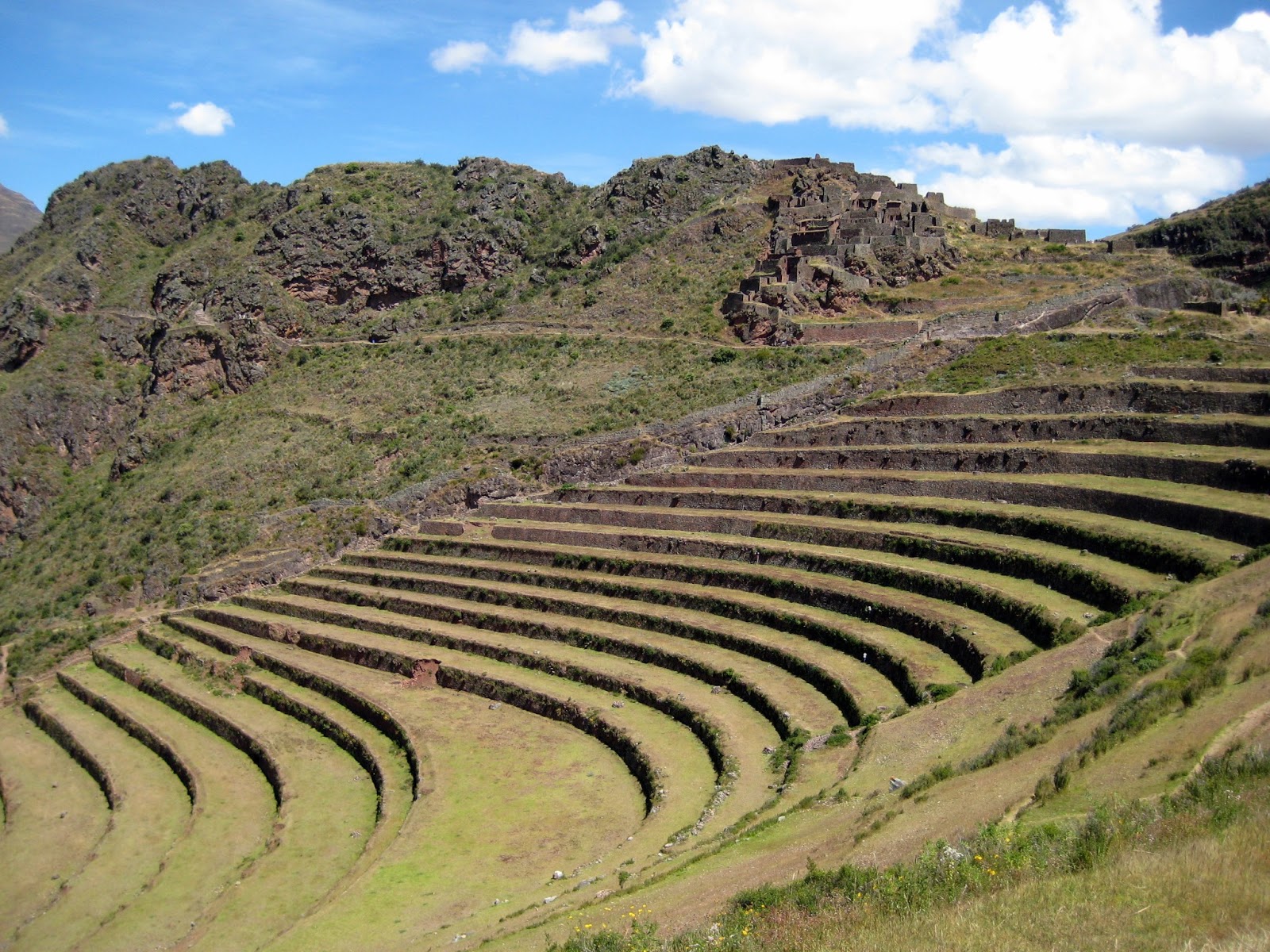
The first stop was at Pisac. After a long ride up to a hilltop, we toured an Inca citadel which also provided a spectacular viewpoint of Pisac's other attraction - the seemingly endless agricultural terraces along the sides of the mountain. There is actually a difference in elevation between the bottom terraces and the top ones such that it accounted for differing climates.  So warm weather crops could be planted near the bottom and cooler weather ones near the top.


Alpacas
We later visited a community which produced and sold various items made from alpaca wool.  They farmed their own herd of alpacas and wove yarn from their fur.  Alpacas and llamas are the essential livestock here and account for many articles of clothing, as well as for meat.  And yes, they are cantankerous creatures and if you get near them they will spit on you. 


The Inca Citadel at Pisac, overlooking the terraces


After this it was time for lunch.  We were treated to another wonderful Panchamanca meal in a remarkable setting in the valley.  This one was very demonstrative of the traditions of the native Quechua people, and included an introduction to a drink called chicha, which is a fermented corn beer.  It even had some unexpected native dancing afterwards.


The scale of Pisac is immense,
and the terraces cover the mountainside

The next stop in the valley was the site of Ollantaytambo.  This site also features a massive Inca fortress overlooking a series of terraces, and is one of the most significant archaeological sites in the valley.  Also, the town itself is the best surviving example of Inca city planing.  It has been continuously inhabited since the 13th century and still has some cobblestone streets constructed by the Incas.  This town is also the beginning of the world renowned Inca Trail.  A typical trek from here to Machu Picchu will take 4 days.  I will definitely be doing this on my next trip to Peru! 

  
The fortress and terraces of Ollantaytanbo


Machu Picchu


A short train ride (about 2 hours) through the Sacred Valley from Cusco brought us to the town of Aguas Calientes.  This town is in a narrow valley at the base of Machu Pichu, and serves as the gateway for almost all tourists. The town itself had the feeling of a resort ski town, where everyone is either a tourist or is catering to the tourists. There are no roads into the city.  The only other way to get there is on foot (via the Inca Trail).  The train seats are typically booked well in advance and it can be hard to plan this trip individually.  So if you are planning a trip here, save yourself a headache and book it through an agent.  Also, don't try to do this as a day trip from Cusco.  It is certainly possible, but staying overnight will allow you to see more and enjoy it without feeling rushed.  I actually was able to spend most of 2 days at the ruins and it was well worth it.  There is actually a hotel just outside the gateway to Machu Picchu -- The Sanctuary Lodge.  But the price is just as steep as the road to get there.  The hotels at the town below are only about a 10 min bus ride away, and about a tenth of the price. So you can decide if it would be worth a splurge.


As with most tourists, this was my primary attraction to Peru... my Bucket List item.  I wanted to see this, and finally I was here.  It definitely lived up to all my expectations.  After a short winding bus ride from the town at the base, we eagerly went through the entrance and into the expansive grounds of the ruins.  Although there were many other tourists there, it did not seem crowded at all. There are many parts to explore, and many places to find a moment of solitude to just take it all in.  And everyone has a camera!  Make sure yours is fully charged and ready to go.  You will use it... a lot!  But being in such a majestic setting as this, it is important to remember that you control the camera.  It does not control you.  Don't focus too much on getting that perfect shot. At some point, make an effort to put the camera away for a time and just enjoy the scenery with your own eyes.  Let it make an impression that you will always remember. 

If you have some time, there are 2 side excursions that I would highly recommend doing while there: 1) Climb to the top of Huayna Picchu.  This is the peak at the far end of the ruins which can be seen in the stereotypical photo.  It looks very steep, but there is actually a trail to the top.  But get there early if you want to do this.  You will need to sign in for a slot at the gate house.  Only a limited number of hikers are allowed past the gate house to the trail (for safety reasons since it is so steep and narrow).  2)  Hike the last portion of the Inca Trail from Machu Picchu to the Sun Gate.  This section is about a mile up a gradual slope, and leads to a fantastic viewpoint overlooking the entire ruins.
The view from the Sun Gate. This gives a good perspective of the access road as well as Machu Picchu.


For a self-guided tour, I highly recommend the guidebook The Machu Picchu Guidebook by Ruth M. Wright and Alfredo Zegarra.  It has a LOT of good information and seems to be the definitive work on this subject.  


Chinchilla

The Sanctuary Lodge, just outside the main entrance to the site


The mountain mist in the early morning 

Trumpet Flowers below the "Guardhouse"


Lima

Lima is basically the gateway to Peru, being its capital and largest city.  This is where my Peruvian adventure began and ended.  Every notable stop on this trip included a culinary lesson.  Here it was ceviche!  Although I have had this style of preparation before, I had never quite understood how it was done.  It always seemed very odd to me that you can "cook" raw seafood simply by immersing it in lime juice at room temperature.  We were treated to a fun demonstration at a local restaurant where they prepared shrimp, scallops, and some sort of white fish in the ceviche style.  It was remarkably simple.  We just squeezed the juice out of a lot of limes, then added chopped red onions and cilantro.  Then we added the seafood and after about 5 mins it was ready to eat.  YUM! I can see why this would be such a fitting meal for a warm climate.  I also was introduced to another seafood specialty: grilled pulpo (octopus).  I had heard that it was a popular item here and I thought that I should at least try it.  And I am glad I did because now I am a big fan of it and have enjoyed it many times since. Just try to avoid getting the suction cups on the tentacles suck to your tongue since it can be very hard to get off.  OK... not really....


Ceviche
We stayed in the Miraflores district, which is considered to be the most affluent neighborhood in Lima.  As such, it is a very comfortable area for tourists and first time visitors (like myself).  It was easy and safe to walk the streets, and there were many shops and restaurants to explore.  The ocean shore was not far either, although there is a high cliff overlooking the water and no real attractions or beaches at the water level.  But it did make it an ideal location for parasailors.  We saw many of them flying over the cliff as we strolled along the cliff side walkway, and were offering rides for $50.

The Cliff walk in Miraflores is worth a stroll

We had an important decision to make on our last night in Peru: Where to eat dinner.  This brought us back to one of our inspirations for this trip -- Rachael Ray's TV segment highlighting some of Lima's finest restaurants. On that show she visited some restaurants in some spectacular settings: La Rosa Nautica located on a huge ocean pier, Huaca Pucllana which dramatically overlooks the pre-Inca ruins of the same name, and Astrid y Gaston which is a pinnacle gastronomical delights.  We chose Astrid y Gaston, which was a good choice since it is now among the world's top 50 restaraunts! At least I can say that I have been to one of them!  And it truly lived up to the expectation. It was the perfect culmination to a memorable trip.  

Final Thoughts
Peru is very inexpensive, and can be a great alternative to Europe in that regard.  But English is not widely spoken here and it is extremely helpful to know some basic Spanish. You do not have to work around the summer/winter seasons.  It really only has 2 seasons: wet and dry (summer is the dry season).  The temperature does not vary much during the year, and is usually moderate.  And as I focused on here, it has some spectacular sights and amazing food.  I found the people to be generally friendly and inviting.  The country in general seemed to have a very casual attitude and was very informal in most places.  For me, this was a fantastic trip and left me with some great memories. 

I highly recommend it to anyone.       


01 April 2013

Reflections on Peru - Part 1


For me... food and travel go together. Great sights should be complimented by great tastes.  You have heard the saying "You are what you eat."  But it is where you eat it that can make it very memorable. 

Peru was my introduction to South America, and to the southern hemisphere. I was drawn to it initially by the mystique of Machu Picchu.  But then I saw a Rachael Ray TV show in which she highlighted the many gourmet restaurants in Lima.  That stirred an inspiration in me to actually consider experiencing it in person. To me, an ideal destination has not only great sights to see, but also great food and beverages to taste along the way. 

I did not really have any references or personal accounts from other travelers to guide me.  So I did some online research and found a tour company which had an attractive website and an itinerary that seemed an ideal fit for me.  The company was Gap Adventures (now just called G Adventures).  The tour was called "Gourmet Peru". It covered all of the sights I really wanted to see, plus it featured some cooking demonstrations and some traditional meals.  I discussed it with my girlfriend and primary travelling companion -- Aimee.  She  did not need any persuading.  So we booked it, and also were able to book free flights with our Skymiles (epic win!!).  And if you are like me, the first thing you do when reading a blog is scroll to the bottom to see how long it is. So I thought best to split this post into 2 parts since it seemed rather lengthy for one post. 

Islas Ballestas
We flew into Lima, arriving late at night (I cover Lima at the end of this post). The next morning we met up with the rest of our tour group and set off.  The morning bus ride gave us a chance to get introduced to the others in our group.  There were only 9 of us, so it was a rather intimate tour and we meshed well together for the entire trip.  I'm always a little skeptical about doing extended tours since the itinerary may be restrictive and you may not like the people you in your group.  But fortunately this was not the case here and I quickly had the sense that I had chosen well.


The first stop was Pisco, where we took a morning boat tour of the Islas Ballestas.  These islands are touted as the "poor man's Galapagos .  It hosts a variety of avian and aquatic life, but most surprising to me were the tropical penguins.  Yes, they are not just in the antarctic or zoos.  But the islands' primary resource is guano (aka avian fecal material), which is highly valued as a fertilizer.  Yeah... we learned to cover our heads here! It was an enjoyable start to our trip.

Pisco - It's not just a drink
Sampling Pisco

Next we toured what Pisco is most famous for: a distillery in which the Pisco liquor was produced.  This is a potent white brandy that is the basis of Peru's (and Chile's) national beverage - the Pisco Sour.  It is a very refreshing cocktail and it seemed to be offered everywhere in Peru.  And it's REALLY good and goes down too easily!  I was also introduced to another common Peruvian beverage: Chicha Morada.  This is a non-alcoholic drink made from purple corn and spices.  If you like the flavor of clove, then you will probably like this.  Now I understand why high fructose corn syrup is the basis of so many other drinks.

While strolling the town, we encountered a street vendor who was selling a strange looking fruit. The Spanish name did not help me, but I recognized it to be similar to a Prickly Pear Cactus fruit.  This was another introduction for me... or as I like to call it: a random food encounter (RFE).  So I had to try it.  Fortunately there was a local couple who were buying the same thing, and they kindly demonstrated how to eat it.  Gestures work very well when language is a barrier!  

The Nazca Lines
The next day we were treated to a plane ride over the mysterious Nazca Lines.  These were created by aliens about 1500 years ago and include a variety of depictions: a hummingbird, a monkey, a spider, an astronaut, several runways for spacecraft, and even an ancient Mr. Potato Head! Apparently these are so well preserved because there is almost no precipitation here.  One can only truly appreciate these formations from the air, and there are plenty of pilots eager to take you for a ride.  And it is well worth the price!  Do it.


A Thunderbird

Ancient spaceport?
Mr. Potato Head alongside an Alien

Now that's a big spider!

Pachamanca

Then it was time for lunch.  For that we were treated to a traditional Peruvian meal: Pachamanca! This ancient style of cooking is distinguished by burying the food in a hole in the ground and then covering it with hot stones.  After about an hour and a half, the food is cooked and ready to eat.  This was mainly a meat and potatoes meal, supplemented with corn and tamales.  Peruvian meals almost always feature some sort of corn or potato.  We enjoyed that meal a lot!


Sand Dunes
This was yet another surprising feature of Peru's many landscapes.  A short ride from Pisco and Ica lie the Huacachina sand dunes.  This area featured some impressive dunes the size of mountains, some over 3000 feet!  Here we boarded a dune buggy for a riding tour of the dunes.  Now I had thought that this would be more of a casual sightseeing tour.  But the driver started out with the pedal to the floor and it turned out to be an adrenaline pumping ride more like a roller coaster, up and down and all 

Sandboarding - the bottom is further than it looks
around the dunes.  We reached the 
peak of one of the tall dunes and our driver stopped and pulled out a sandboard.  This was something like a desert snowboard.  He waxed it up, looked at us and said "Who wants to go first?"   I was not really prepared for this, or I would have worn different clothing.  But Aimee bravely volunteered to be the first down the hill.  She got on and zipped downhill head first.  You can't really steer or stop a sandboard without getting a lot of sand in your face.  You just have to go until it stops.  After about 10 seconds, her ride ended and she got up with a big grin on her face (So big I could see it from the top of the dune where I was).  We all took our turns riding down and repeated it on several other hills. It was a lot of fun and a very welcome surprise.  And yes, we continued to empty out a lot of sand from those clothes over the next few days.

Arequipa
Our ingredients for the cooking demo 
After an overnight bus ride from Nazca, we arrived in Arequipa.  It is the second most populous city in Peru, and is ominously located at the base of a  volcano.  It has a picturesque plaza at the center of the city, and has a very colonial appearance but cosmopolitan feel.  We spent most of a day just walking around the city.  For lunch, we were treated to a cooking demonstration. It featured stuffed peppers with rocoto sauce, lomo saltado (a common Peruvian dish with yet another meat-and-potatoes variation), hand lots of other yummyness (I can't remember it all!).


Stuffed Pepper
Lomo Saltado


After lunch we visited the Santa Catalina Monastery.  This historic colonial landmark is characterized by its expansive colorful buildings and serene courtyards.  It is a fun place to just explore and find some solitude in a serene setting. And also a great place to use your camera!


Wall of flower pots Santa Catalina
Courtyard at Santa Catalina


We left Arequipa from the airport, and boarded a short flight to Cusco. The airport runway is next to the base of a volcano.  It was very unusual to see a huge mountain out of your window as you are taking off.  But landing is probably hair raising!

Arequipa Airport under the volcano

The next post will resume in Cusco, and will also cover the absolute highlight of the trip - Machu Picchu.

Continued in Part 2...


21 January 2013

A Year of Reconnecting (and disconnecting)

        
The substance of a relationship can be measured by how long it takes to get reacquainted after a long separation.  - Timothy Crouse
As I reflect upon the past year, I would label 2012 as a year of reconnecting for me. But it has also had much disconnecting.

First, My Disconnections.

2012 has brought many relational changes for me.  My co-workers are in many ways like a family to me.  Together we talk, laugh, walk, eat, drink, work, and generally share in each others lives.  So it is always disrupting when someone leaves that family.  Several have chosen to retire. Some have left to work elsewhere.  Others have left in the worst way possible, having lost battles to fatal illnesses. There is simply no more sobering experience than attending the funeral of someone younger than me (since I am in my early 40's).  And still others have left to fight their ongoing illnesses.

Fortunately we are in an era where communication is easier than ever.  This makes it easier than ever to stay in touch with those I no longer see on a daily basis.  But it still takes some effort to maintain these relationships, especially if they are not yet on board with any social networking application.  I am happy that I see my retired friends as often as I do, and even happier to see how much they are enjoying their lives.

My Reconnections

Many relationships from my past have come back into my life this past year.  They have come through social networking, a wedding, a high school reunion, as well as through personal visits.   A strong desire to reconcile these friendships was sparked through something that started as a household cleaning chore. As I was rearranging some items in my house I came across what I will refer to as "The Box".  

It was somewhat of a personal time capsule for me.  It started when I was in high school.  Upon my graduation I received so many nice cards from my friends and family and I didn't really know what to do with them.  I felt bad about throwing them away, so I just stored them in a shoe box. Over time I continued to add birthday cards, holiday cards, and any personal letters I had received.  The shoe box was replaced by a bigger box, and it has stayed with me for about 25 years. Oddly enough, I seem to have stopped adding to it sometime around the advent of email.  I was doing some much needed purging, so I was opening up each box and storage bin to decide what I actually needed to keep.  Inevitably I opened "The Box". It occurred to me that I had never actually taken anything out of it or read through any of its contents.  Until that point I had only added things to it.  So I became very curious and I spontaneously decided to open it up and check out its contents.  Several hours later I closed it up, having reread most of the cards and letters.  In that short time I had gone through a full range of emotions: happiness, grief, love, heartbreak, and everything between.  Mostly they evoked fond memories of many great relationships. I sadly realized that hardly any of those relationships were a part of my present life.  But there were also some "difficult" ones as well which had ended with painful abruptness.  Fortunately, time has a unique way of healing that which nothing else can.  

So I made a resolution then to at least get back in touch with those who where once my best of friends.  And I have made great progress toward this goal so far.  I have been extremely blessed with the reunions I have had during the year, and I look forward to bringing more back into my life this year.  

No one seems very far away in this era of mobile phones, social networks, and of course airplanes.  I can't say that I have ever regretted spending time or money on travel, especially when it is for visiting with a friend or relative.  There is simply no substitute for a face to face conversation.  I am always reminded that no one in the US is more than a few hours away,  and given a day you can be almost anywhere in the world.  All it takes is time and money. Yes... I know... there is usually a shortage of both!  Maybe that's why they just seem to slip away...

My Resolution

So that's my resolution for 2013: not just to contact people, but to see them as well.  As many of them as I can anyway.  I never need an excuse to travel, but that is as good of one as there can be.