For me... food and travel go together. Great sights should be complimented by great tastes. You have heard the saying "You are what you eat." But it is where you eat it that can make it very memorable.
Peru was my introduction to South America, and to the southern hemisphere. I was drawn to it initially by the mystique of Machu Picchu. But then I saw a Rachael Ray TV show in which she highlighted the many gourmet restaurants in Lima. That stirred an inspiration in me to actually consider experiencing it in person. To me, an ideal destination has not only great sights to see, but also great food and beverages to taste along the way.
I did not really have any references or personal accounts from other travelers to guide me. So I did some online research and found a tour company which had an attractive website and an itinerary that seemed an ideal fit for me. The company was Gap Adventures (now just called G Adventures). The tour was called "Gourmet Peru". It covered all of the sights I really wanted to see, plus it featured some cooking demonstrations and some traditional meals. I discussed it with my girlfriend and primary travelling companion -- Aimee. She did not need any persuading. So we booked it, and also were able to book free flights with our Skymiles (epic win!!). And if you are like me, the first thing you do when reading a blog is scroll to the bottom to see how long it is. So I thought best to split this post into 2 parts since it seemed rather lengthy for one post.
Islas Ballestas
We flew into Lima, arriving late at night (I cover Lima at the end of this post). The next morning we met up with the rest of our tour group and set off. The morning bus ride gave us a chance to get introduced to the others in our group. There were only 9 of us, so it was a rather intimate tour and we meshed well together for the entire trip. I'm always a little skeptical about doing extended tours since the itinerary may be restrictive and you may not like the people you in your group. But fortunately this was not the case here and I quickly had the sense that I had chosen well.
.jpg)
.jpg)
The first stop was Pisco, where we took a morning boat tour of the Islas Ballestas. These islands are touted as the "poor man's Galapagos . It hosts a variety of avian and aquatic life, but most surprising to me were the tropical penguins. Yes, they are not just in the antarctic or zoos. But the islands' primary resource is guano (aka avian fecal material), which is highly valued as a fertilizer. Yeah... we learned to cover our heads here! It was an enjoyable start to our trip.
Pisco - It's not just a drink
.jpg) |
| Sampling Pisco |
Next we toured what Pisco is most famous for: a distillery in which the Pisco liquor was produced. This is a potent white brandy that is the basis of Peru's (and Chile's) national beverage - the Pisco Sour. It is a very refreshing cocktail and it seemed to be offered everywhere in Peru. And it's REALLY good and goes down too easily! I was also introduced to another common Peruvian beverage: Chicha Morada. This is a non-alcoholic drink made from purple corn and spices. If you like the flavor of clove, then you will probably like this. Now I understand why high fructose corn syrup is the basis of so many other drinks.
While strolling the town, we encountered a street vendor who was selling a strange looking fruit. The Spanish name did not help me, but I recognized it to be similar to a Prickly Pear Cactus fruit. This was another introduction for me... or as I like to call it: a random food encounter (RFE). So I had to try it. Fortunately there was a local couple who were buying the same thing, and they kindly demonstrated how to eat it. Gestures work very well when language is a barrier!
The Nazca Lines
The next day we were treated to a plane ride over the mysterious Nazca Lines. These were created by aliens about 1500 years ago and include a variety of depictions: a hummingbird, a monkey, a spider, an astronaut, several runways for spacecraft, and even an ancient Mr. Potato Head! Apparently these are so well preserved because there is almost no precipitation here. One can only truly appreciate these formations from the air, and there are plenty of pilots eager to take you for a ride. And it is well worth the price! Do it.
.jpg) |
| A Thunderbird |
.jpg) |
| Ancient spaceport? |
.jpg) |
| Mr. Potato Head alongside an Alien |
.jpg) |
| Now that's a big spider! |
Pachamanca
.jpg) Then it was time for lunch. For that we were treated to a traditional Peruvian meal: Pachamanca! This ancient style of cooking is distinguished by burying the food in a hole in the ground and then covering it with hot stones. After about an hour and a half, the food is cooked and ready to eat. This was mainly a meat and potatoes meal, supplemented with corn and tamales. Peruvian meals almost always feature some sort of corn or potato. We enjoyed that meal a lot!
Sand Dunes
This was yet another surprising feature of Peru's many landscapes. A short ride from Pisco and Ica lie the Huacachina sand dunes. This area featured some impressive dunes the size of mountains, some over 3000 feet! Here we boarded a dune buggy for a riding tour of the dunes. Now I had thought that this would be more of a casual sightseeing tour. But the driver started out with the pedal to the floor and it turned out to be an adrenaline pumping ride more like a roller coaster, up and down and all
Then it was time for lunch. For that we were treated to a traditional Peruvian meal: Pachamanca! This ancient style of cooking is distinguished by burying the food in a hole in the ground and then covering it with hot stones. After about an hour and a half, the food is cooked and ready to eat. This was mainly a meat and potatoes meal, supplemented with corn and tamales. Peruvian meals almost always feature some sort of corn or potato. We enjoyed that meal a lot!
Sand Dunes
This was yet another surprising feature of Peru's many landscapes. A short ride from Pisco and Ica lie the Huacachina sand dunes. This area featured some impressive dunes the size of mountains, some over 3000 feet! Here we boarded a dune buggy for a riding tour of the dunes. Now I had thought that this would be more of a casual sightseeing tour. But the driver started out with the pedal to the floor and it turned out to be an adrenaline pumping ride more like a roller coaster, up and down and all
.jpg) |
| Sandboarding - the bottom is further than it looks |
around the dunes. We reached the
peak of one of the tall dunes and our driver stopped and pulled out a sandboard. This was something like a desert snowboard. He waxed it up, looked at us and said "Who wants to go first?" I was not really prepared for this, or I would have worn different clothing. But Aimee bravely volunteered to be the first down the hill. She got on and zipped downhill head first. You can't really steer or stop a sandboard without getting a lot of sand in your face. You just have to go until it stops. After about 10 seconds, her ride ended and she got up with a big grin on her face (So big I could see it from the top of the dune where I was). We all took our turns riding down and repeated it on several other hills. It was a lot of fun and a very welcome surprise. And yes, we continued to empty out a lot of sand from those clothes over the next few days.
Arequipa
.jpg) |
| Our ingredients for the cooking demo |
After an overnight bus ride from Nazca, we arrived in Arequipa. It is the second most populous city in Peru, and is ominously located at the base of a volcano. It has a picturesque plaza at the center of the city, and has a very colonial appearance but cosmopolitan feel. We spent most of a day just walking around the city. For lunch, we were treated to a cooking demonstration. It featured stuffed peppers with rocoto sauce, lomo saltado (a common Peruvian dish with yet another meat-and-potatoes variation), hand lots of other yummyness (I can't remember it all!).
.jpg) |
| Stuffed Pepper |
.jpg) |
| Lomo Saltado |
After lunch we visited the Santa Catalina Monastery. This historic colonial landmark is characterized by its expansive colorful buildings and serene courtyards. It is a fun place to just explore and find some solitude in a serene setting. And also a great place to use your camera!
.jpg) |
| Wall of flower pots Santa Catalina |
.jpg) |
| Courtyard at Santa Catalina |
We left Arequipa from the airport, and boarded a short flight to Cusco. The airport runway is next to the base of a volcano. It was very unusual to see a huge mountain out of your window as you are taking off. But landing is probably hair raising!
.jpg) |
| Arequipa Airport under the volcano |
The next post will resume in Cusco, and will also cover the absolute highlight of the trip - Machu Picchu.
Continued in Part 2...
.jpg)
.jpg)


.jpg)
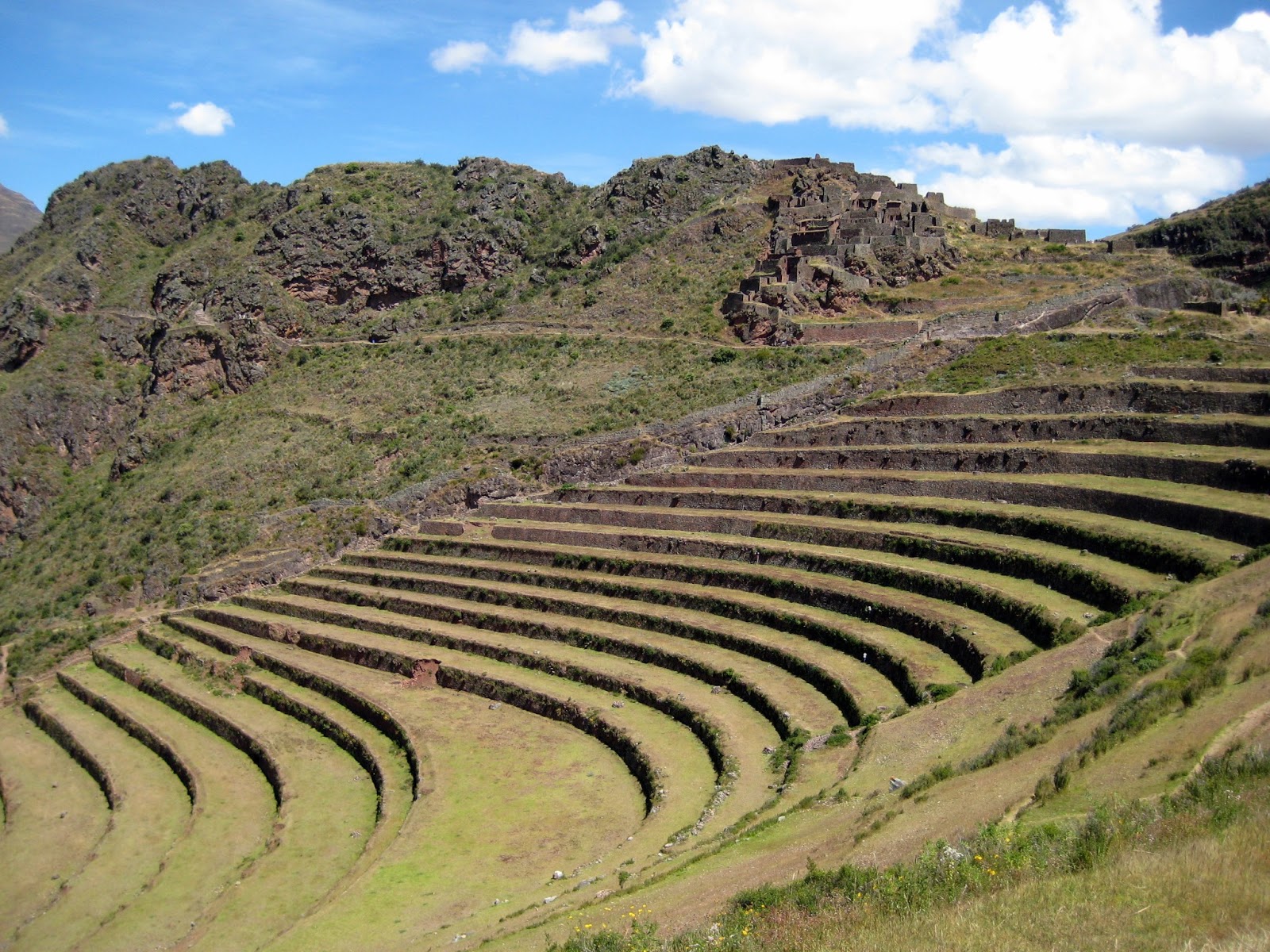
 This valley near Cusco is featured prominently on most tourist maps. This is due to the combination of its incredible scenery and some very significant Inca archaeological sites. We enjoyed a very scenic drive here which lasted most of the day.

.jpg)
.jpg)
.jpg) As with most tourists, this was my primary attraction to Peru... my Bucket List item. I wanted to see this, and finally I was here. It definitely lived up to all my expectations. After a short winding bus ride from the town at the base, we eagerly went through the entrance and into the expansive grounds of the ruins. Although there were many other tourists there, it did not seem crowded at all. There are many parts to explore, and many places to find a moment of solitude to just take it all in. And everyone has a camera! Make sure yours is fully charged and ready to go. You will use it... a lot! But being in such a majestic setting as this, it is important to remember that you control the camera. It does not control you. Don't focus too much on getting that perfect shot. At some point, make an effort to put the camera away for a time and just enjoy the scenery with your own eyes. Let it make an impression that you will always remember.
As with most tourists, this was my primary attraction to Peru... my Bucket List item. I wanted to see this, and finally I was here. It definitely lived up to all my expectations. After a short winding bus ride from the town at the base, we eagerly went through the entrance and into the expansive grounds of the ruins. Although there were many other tourists there, it did not seem crowded at all. There are many parts to explore, and many places to find a moment of solitude to just take it all in. And everyone has a camera! Make sure yours is fully charged and ready to go. You will use it... a lot! But being in such a majestic setting as this, it is important to remember that you control the camera. It does not control you. Don't focus too much on getting that perfect shot. At some point, make an effort to put the camera away for a time and just enjoy the scenery with your own eyes. Let it make an impression that you will always remember. .jpg)
.jpg)
.jpg)
.jpg)
.jpg)
.jpg)
.jpg)

.jpg)
.jpg)
.jpg)
.jpg)
.jpg)
.jpg)
.jpg)
.jpg)
.jpg)
.jpg)
.jpg)
.jpg)
.jpg)
.jpg)
.jpg)
.jpg)
.jpg)
.jpg)